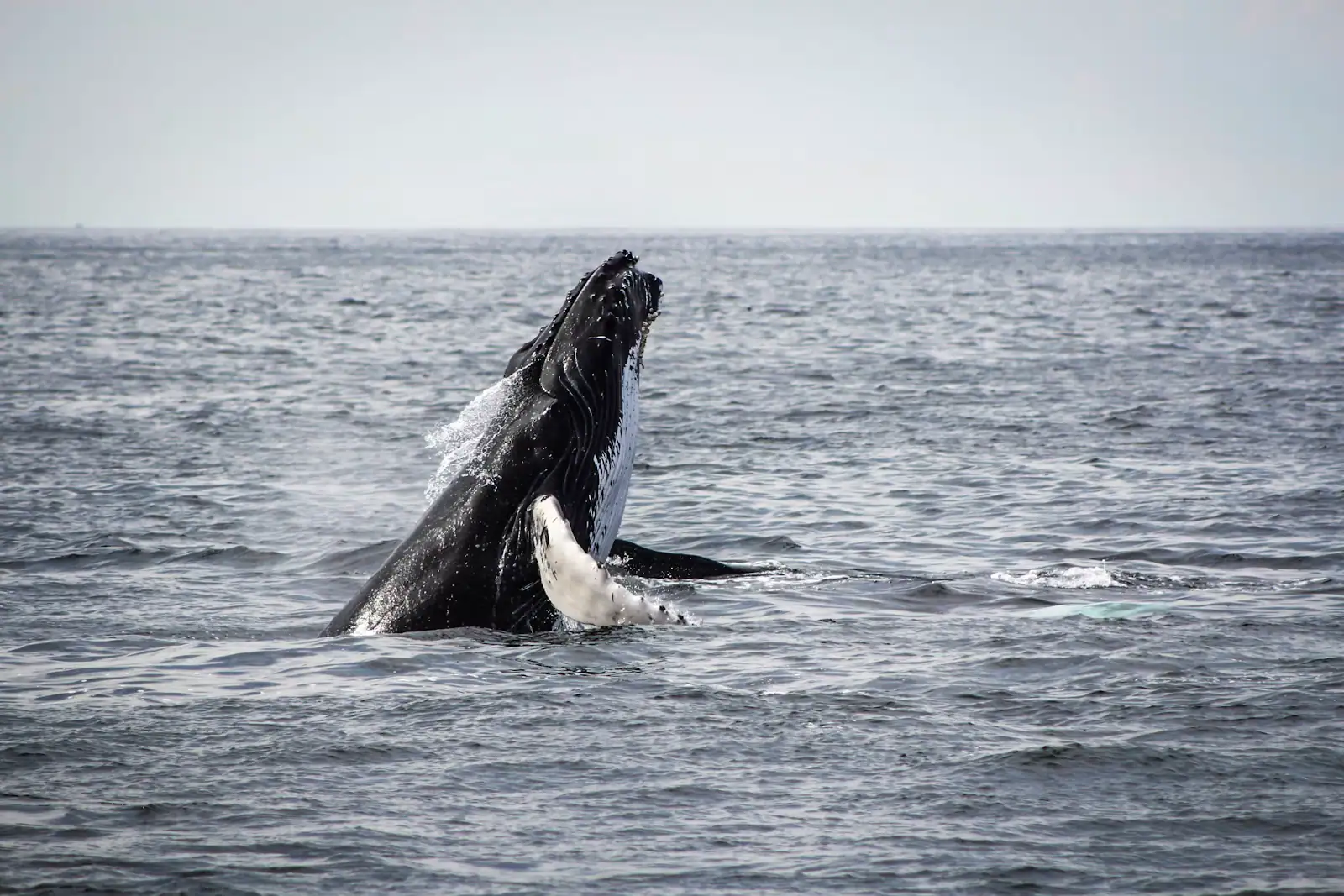
Koholā, the North Pacific humpback, feeds off Alaska through the northern summer and crosses to Hawaiʻi to breed and calve. Something close to ten thousand make that crossing, and a large share of them settle into Maui Nui — the shelf ringed by Maui, Molokaʻi, Lānaʻi and Kahoʻolawe, much of it under 600 feet deep and screened from open swell. The Auʻau Channel, the strip of flat water between West Maui and Lānaʻi, is reckoned one of the densest humpback breeding grounds on earth. That is what makes a Maui winter different from a whale trip anywhere else. The animals are not somewhere offshore. They are in the gap between two islands you can see across.
Dates worth booking around
November produces the first blows and they stay sporadic. December climbs. January, February and March are the season proper, February thickest of the three and the month with the most breaching, pec-slapping and competitive surface behaviour. April tails off. By May you are down to stragglers.
Book February if the whales are the reason for the trip. Mid-December to early April will do if they are a bonus rather than the point.
The free version, from land
You do not have to buy a ticket. Papawai Point, on the Honoapiʻilani Highway between Māʻalaea and Olowalu, is the best-known roadside lookout because the headland shoulders into the channel and animals pass close to it. The lay-by is small, so pull fully in; stopping on the highway itself is how people get hit.
The Wailea coastal path, Kāʻanapali Beach, the short steep climb up Puʻu Ōlaʻi at Mākena and the exposed Lahaina Pali Trail all look out over the same water from different heights. Work the horizon for the blow first — a bushy column that hangs a couple of seconds — and only then try to find the body under it.
Which harbour your boat leaves from
Most of the fleet works out of Māʻalaea Harbor at the pinched waist of the island, which puts you into the channel inside twenty minutes. Rafts launch off the sand at Kāʻanapali for a shorter, wetter, more exposed ride. Lahaina Harbor has been in a phased reopening since December 2025 under the state Division of Boating and Ocean Recreation's recovery programme — daytime operations only while harbour lighting is restored, with operators returning in stages through 2026 — so confirm what is actually sailing from there rather than trusting a cached listing.
Two hours is the standard trip. Afternoon boats are cheaper and the wind through Māʻalaea is stronger by then; the first departure of the day buys the calmer water.
What your captain may and may not do
Federal law fixes the distance at 100 yards. Nobody may close inside it on or in the water — hull, kayak, paddleboard, outrigger canoe, swimmer, the same boundary for all of them — and an aircraft must hold 1,000 feet, which is the line a drone is held to as well. There is no seasonal carve-out and no boundary to step outside of: the rule runs year-round through every Hawaiian water out to 200 nautical miles, and NOAA's Office of Law Enforcement works it alongside the Coast Guard and the state's conservation enforcement officers.
On a Maui boat that comes down to the difference between waiting and chasing. A captain who takes the engine out of gear and lets a pod decide is working correctly, and a whale that surfaces beside a stationary hull is the best morning anyone on board will get — the regulation forbids you approaching the animal, not the animal approaching you. A captain who keeps easing ahead of a travelling pod to hold the shot is committing an offence with a deck full of paying witnesses.
Telling a good operator from a bad one
- Listen to the pre-departure briefing. A crew that states the 100-yard rule before the lines come off is a crew that expects to be held to it.
- Watch the throttle rather than the whale. Repeated repositioning ahead of moving animals is the tell.
- Ask whether a naturalist is aboard. Several Māʻalaea operators carry one and log sightings for research programmes, which is the difference between a boat ride and an hour of learning something.
- Read the guarantee. A promise of a free repeat trip is honest. A promise of a whale is not.
They are not here to eat
Humpbacks take no food in Hawaiʻi. They arrive fat from Alaska and burn it down over the winter. Every behaviour you will watch in the Auʻau Channel — the breaching, the escort pods shouldering each other, the long male song that carries up through the hull — is breeding, calving or communication. None of it is a meal.